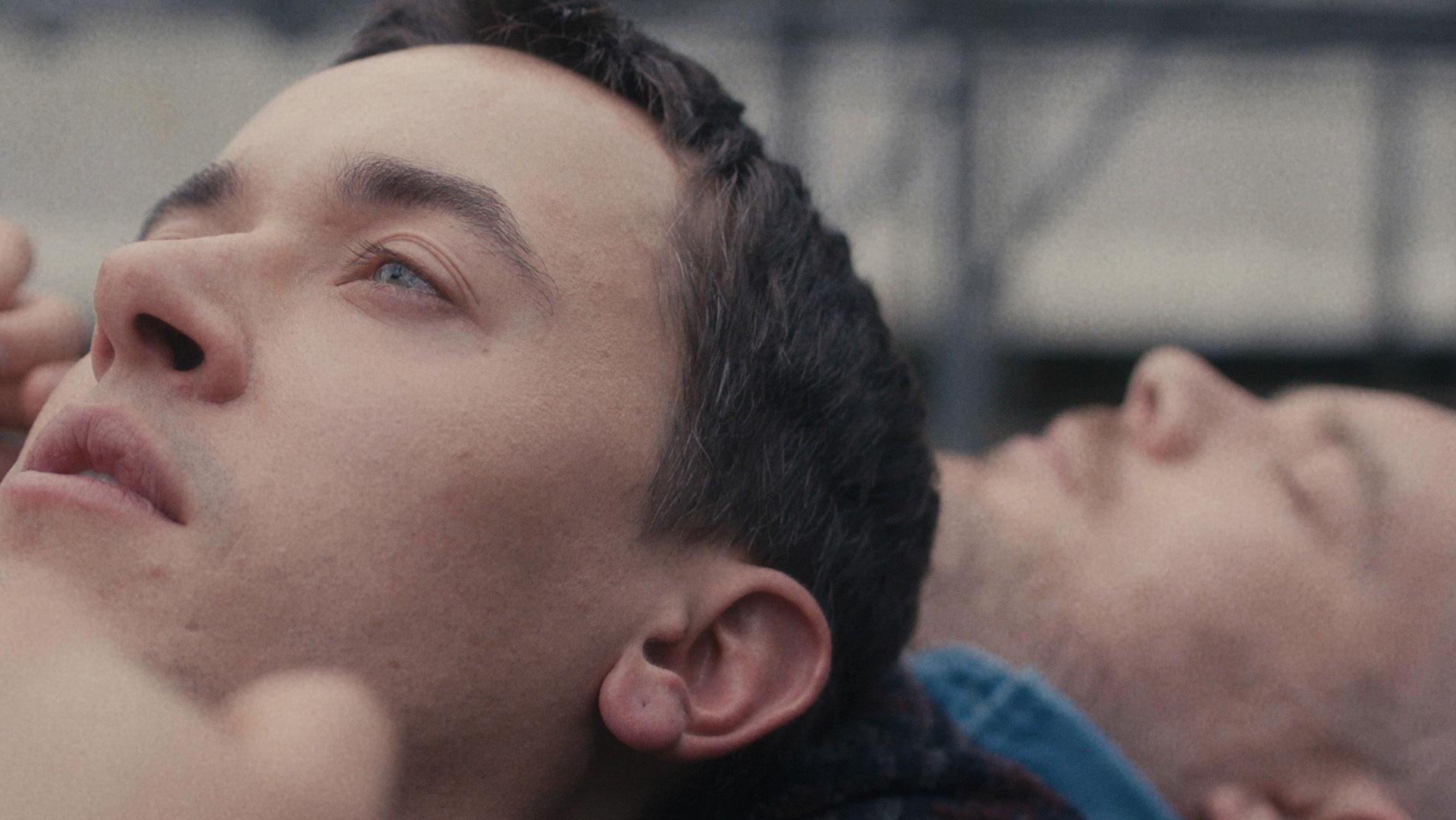
Just shy of three weeks ago I went to the cinema with a friend to watch The Long Walk, but we arrived late and missed the screening. Not wanting to call the trip quits, we had a look at what else was starting soon and found a film called Plainclothes that neither of us had heard of – in fact, the member of staff at the ticket desk hadn’t heard of it either. They read us the brief description of the film, but other than that we went into the screening blind, which is always an exciting cinema experience, though risky, too, since there is a chance that the film could be total drivel. As it turns out, the risk paid off, with Plainclothes proving to be a fantastic watch, and with its director Carmen Emmi now placed firmly on my radar.
From the opening shots I suppose I was inclined to feel more favourable towards Plainclothes than I do towards most other new releases due to its grittier, grainy look. I’ve long abhorred (a strong word, I know, but I think a strong word is required here) the smooth, polished look that has taken over films in recent years and has apparently become the definition of what it means for a shot to look ‘cinematic.’ There is of course nothing wrong with this style, or look, itself, and in many cases such a flawless, pristine look is what suits a film best. My issue with this look, and with it having become synonymous with the term ‘cinematic,’ is that filmmakers and film students today seem blinded to the possibility that a film can look different from this template style and still be ‘cinematic.’ As a result, this clean, picture-perfect look is adopted without question for all films regardless of subject matter, intended atmosphere, or intended emotion. Consequently, cinemas are full with films that, no matter how different their stories, genres, characters, or themes, all look the same, and the majority of these films feel flat, emotionless, empty, unmoving. This is because this ‘cinematic’ look is not appropriate for all films, and as such rather than the picture-perfect shots adding beauty and feeling to a film, often the reverse is achieved as scenes become sterilised of nearly all atmosphere and emotion. For this reason, Plainclothes was an extremely refreshing new release.
Rather than adopting this so-called ‘cinematic’ template look, Carmen Emmi opted for a look that would complement and emphasise the emotional core of the film, a choice that should be commonplace among filmmakers but that in the current cinematic climate feels bold and daring. We open on a grainy digital camera shot of Lucas, brilliantly portrayed by Tom Blyth, sat in his car, staring past us. Immediately, from Emmi’s choice to film with a rawer, less polished look, I’m drawn a little closer to this stranger in the car than I ordinarily might be. It doesn’t look like the director has tried to erase every imperfection, or like he has had to use a crew of one-hundred gaffers and sparks to perfectly balance the light and the shadows. Instead, it feels more intimate, and it feels less staged, and in feeling less staged it feels a little more authentic, a little more genuine, and the shot instantly has a little extra depth to it. As this opening scene unfolded, there was a worry in my mind that the film wouldn’t be brave enough to maintain this style for its whole duration, that it would abandon this rougher look after the opening scene and I’d be left disappointed in the same way I was when Longlegs didn’t keep its 4:3 aspect ratio past the opening scene. With great relief and excitement, my worries didn’t materialise. Emmi keeps this look for the duration of the film, and in doing so he has, for me at least, hinted that he could be one of the most brave and exciting filmmakers working at current.
As the film progresses, we are graced with further evidence that Emmi’s directorial style is a step away (in the right direction) from his contemporaries as certain moments and stylistic choices show off an experimental and creative side that is sorely missed in the cinema right now. Before going into detail of what these moments are, I think it necessary to give a brief overview of the plot of the film in order to make clear how Emmi’s creative choices impact the story and its themes. In short, Plainclothes tells the story of an undercover cop, Lucas, in 90s New York who works to entrap gay men in public lavatories and then charge them with public indecency. Lucas, however, is himself closeted and on one such assignment he feels an attraction to the man, Andrew, whom he is supposed to be entrapping. Lucas botches the mission and a secret relationship between the two men is set in motion. There are several instances throughout Plainclothes’s runtime when the shaky, slightly grainy digital look suddenly switches to very grainy VHS footage while the composition of the shot itself remains unchanged. That is to say, the shot itself is the exact same shot (same angle, same subject, same distance from the camera), but the look of the shot changes to suggest that we are now looking at the scene through a different, older, camera. No explicit explanation is ever given as to why this is done, and it was my friend who I watched the film with who pointed out that these moments of VHS footage had the same look as the police footage that Lucas and his colleagues are shown while being assigned their task. What is suggested through these switches to VHS footage, then, is the sense that these characters are under constant surveillance. Unless my memory fails me, all, or at least the majority, of these moments come when we are looking at something from Lucas’s point of view. This choice by Emmi not only heightens the anxiety and paranoia that courses through the film’s core and that is ever-present in Blyth’s superb performance, but it also calls to attention the inner struggle that is tearing Lucas apart as his identity as a cop and his identity as a gay man become seemingly incompatible under the laws and stigmas of such a homophobic society. Lucas may look at first with longing, or desire, or love, but these emotions are quickly and uncontrollably overshadowed by a feeling that what he feels is wrong, a decision by Emmi that infuses the film with a constant underlying tragedy and sadness.
In other moments, Emmi mixes in home video footage of Lucas as a child. At times, these little clips appear as the transition between two scenes, and in other moments, especially as we near the climax of the film and Lucas’s quiet demeaner edges closer to breaking point, they serve as part of a montage-esq carousel of memories and grief that are spiralling around Lucas’s head. These shots, though presenting Lucas’s childhood as a happy one, are imbued with a sadness and a regret. The person behind the camera is Lucas’s father, but the memory is Lucas’s, and what we are reminded of in these moments is that Lucas’s father died not ever knowing that his son was gay, and as such not ever wholly knowing his son. Through these shots of Lucas as a child, we can feel the adult Lucas’s regret and sadness at never confiding (or being able to confide) in his father before it was too late. In this way, Lucas’s grief at the death of his father carries a weight different to the rest of his family; it is a very personal grief, one that the others cannot sympathise with, and one that he cannot share with them. The look of these shots, seemingly filmed on a cheap home camera, differs again from both the look employed for the film at large, and the look of the VHS security footage. Emmi, then, in Plainclothes, has created a film patched together from apparently three different cameras and three different visual styles; and this isn’t merely an act of creative flair that serves no purpose beyond its aesthetic. Lucas, in being a closeted gay man, leads several lives at once. To his family and his friends, he is a straight man and a police officer. To his colleagues, an undercover cop – we presume his family doesn’t know the assignment he is on. To all of these, he is a man struggling with grief following the passing of his father. But to himself, and to his ex-girlfriend and to Andrew, he is a gay man, and his sadness and his anxiety stems not only from the death of his father, but from his inability to share his whole identity, and his whole grief, with those around him. With a mother who is eager for grandchildren, and with an ultra-macho, homophobic uncle living at his mother’s place, Lucas feels not only incapable of sharing this side of himself with those around him, but he actively fears his secret getting out, and this fear spirals into a consuming paranoia, anxiety, and distrust. Emmi’s mixture of three different cameras and filming styles acts as a visual representation of this divide in Lucas’s identity, and of the emotions that are consuming him. And as the film nears its finale, and as Lucas simultaneously becomes more torn by this divide in his self and more overwhelmed by his grief and his paranoia, these three different styles chop and change more frantically, mirroring what Lucas is feeling and creating this anxiety onscreen for the audience to feel as well.
There were other directorial choices by Emmi that stood out to me that I will mention briefly, but which I won’t dwell on for long for it was the visual style I most wished to discuss, as it was this that, above all else, made Plainclothes stand out to me above other recent releases. However, another element employed by Emmi worthy of note though is the aptly handled use of a non-linear structure. Again, rather than being used simply to make the film different or to add a layer of excitement to it, the non-linear structure of Plainclothes goes a way in complementing the various visual styles in their representation of Lucas’s mental and emotional state. In cutting between various times in Lucas’s life, both before and after his father’s passing, before and after the end of his relationship with his girlfriend, and before and after his meeting with Andrew, Lucas’s complicated and frustrated identity is emphasised as we witness a mashup of various instances in his life, one event following another non-chronologically to suggest, once again, that Lucas lives several identities at one time. The fact that Emmi achieves all this without ever over-complicating the plot or losing the audience is another credit to his directing abilities.
Something else that stood out to me was Emmi’s handling of the gay sex scenes, which, refreshingly, were shown to us instead of merely being implied. Still, too often, films shy away from lingering on gay sex scenes in the same way they linger on straight sex scenes, choosing instead to cut away just after the intimacy is initiated, or to film the scenes in a ‘stylistic’ way such as with silhouettes, which in reality doesn’t feel stylistic at all, but rather feels like a poor attempt to hide the fact that, despite the subject matter, they’re still catering to the gaze of the status quo – that of a straight man. Emmi, in contrast, adopts an intimate camera in these scenes that lingers with Lucas and Andrew, that keeps its grainy, shaky look and with that its authenticity and emotion. The scenes don’t feel staged or performative, instead they feel raw and full of emotion and passion, something that is necessary for the character of Lucas and for the themes that sit at the heart of Plainclothes – for were we not to witness these moments we would struggle to gauge just how important this relationship is for Lucas – but that is also an important and exciting choice to see in the world of filmmaking in general, as Emmi shows that he isn’t here to stick to the status quo, but is here to show the stories he wants to show in the way he wants to show them.
All in all, in its dealing with familiar themes and a familiar and fairly unambitious story, but with a low-budget look (a compliment from me) and in a stylistic way that feels creative and offers hints of originality, Plainclothes has all the hallmarks of a debut feature from an exciting new director. The film lacks the depth and commanding originality of an established auteur, and Emmi relies on the occasional familiar trope (macho homophobic uncle, for example) to push the narrative in certain directions, but the way in which he presents these familiarities with such tenderness and control, and the stylistic choices he makes in the film’s visual style make this a debut worthy of note, alongside such other debuts as Ana Lily Amirpour’s A Girl Walks Home Alone at Night from a decade prior. It is not often that a debut feature offers such promise of exciting things to come, but in his rejection of the overused ‘cinematic’ template style, and in the moments of originality that he graces us with, Emmi has created with Plainclothes a feature that has restored in me a little bit of faith in independent cinema, and that has placed Emmi firmly on my radar as a filmmaker to keep an eye on in the future. I only hope that should he return with a larger budget for his next feature, that he doesn’t, as a consequence, lose any of the creative daring that he’s demonstrated here.
November 4th, 2025

 benedicthutchinson.com