Dogville is my fourth Lars von Trier and the first film I’ve watched in a long time that left me completely in the dark as to whether I liked it or not, let alone what I would rate it out of five. Oddly, the last time I felt a similar uncertainty at a film’s close was after watching Bergman’s The Seventh Seal, though the reasons for the uncertainty in each case were – just like the films – very different. Now when I talk about me liking a film or not, I do not refer to whether I enjoyed it as such – for I’m not sure how much one can enjoy a von Trier movie – but rather I refer to whether it impacted me in any sort of meaningful way; if it succeeded in producing in me the intended emotions; if it was successful in being what it wanted to – or should – be. Vague, I know, but I’m still figuring this stuff out for myself. But in short, whether or not I like a film is not dependent on whether I had a good time watching it; I tend to just have a feeling that I liked it, or I didn’t like it. This was not the case with Dogville.
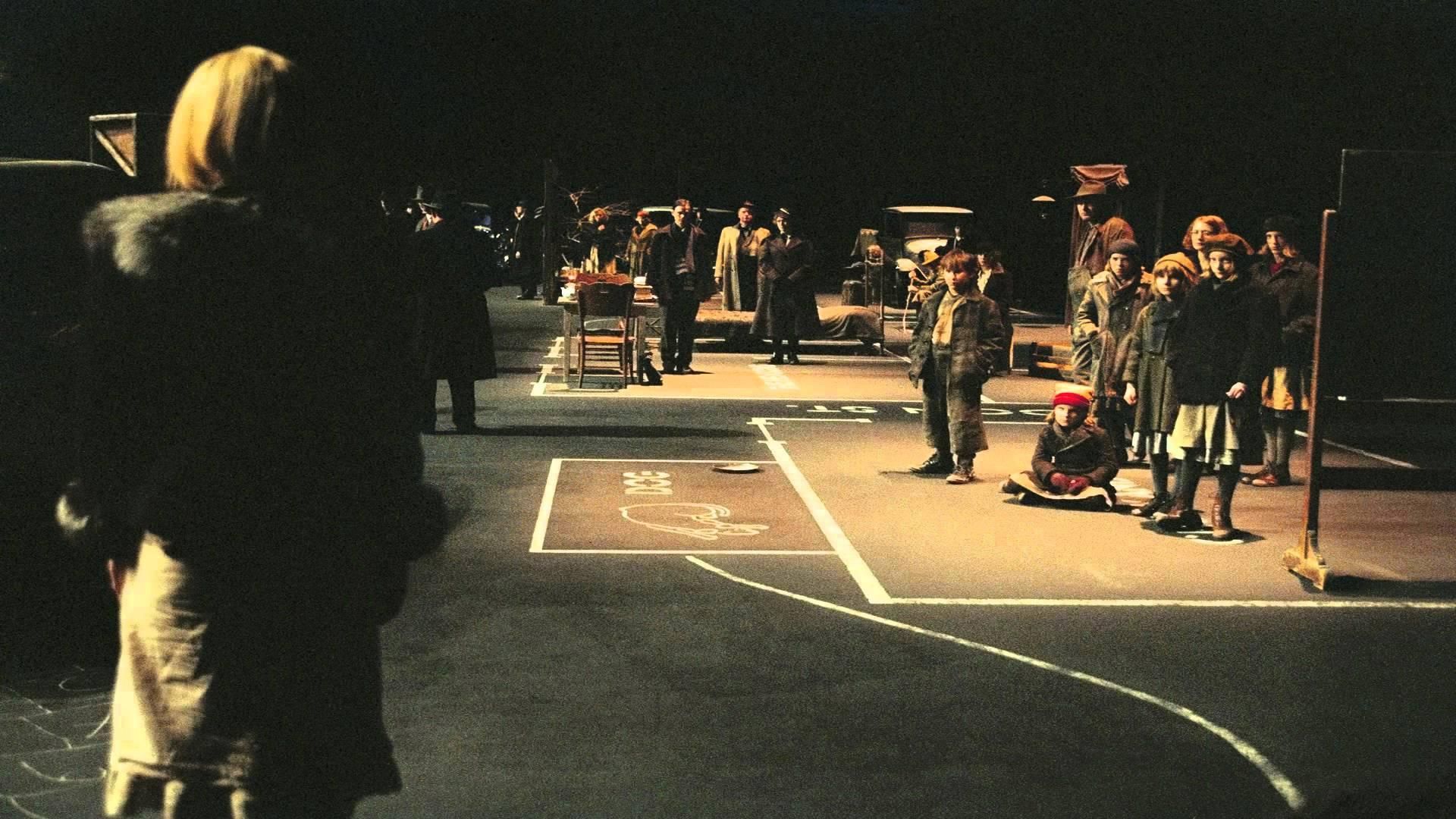
The film’s opening bird’s eye-view shot shows us a minimalist stage-like set, upon which, other than a few pieces of set design – an odd piece of wall; a church spire; a desk; some wooden frames to represent an abandoned silver mine – exists only the outline of each of the town’s houses drawn on the floor in white chalk, along with an accompanying label to denote who lives there – i.e. ‘Olivia and June.’ It is so sparse that at first glance it appears to be but a rough drawing of the town, a quick way for von Trier to familiarise us with the layout of the town, perhaps, before we cut to the real setting. In fact, this is the ‘real’ setting. As the camera slowly zooms in, we see the ‘town’ come to life as the actors start to move about on stage, opening and closing the imaginary doors to their houses as theatre actors would, not opening and closing real doors as we have come to expect film actors to do. It is a jarring experience for we tend to come to a film with the assumption that we won’t have to suspend our belief to the same extent that we do when we go to the theatre. Thus, right from the get-go von Trier challenges our notions of what constitutes cinema, as he blends together two similar but also significantly different viewing experiences – that of an audience for a play, and an audience for a film. When watching a play in a theatre, the audience’s viewing experience is restricted in the sense that they can see only what their position in the auditorium permits them, in contrast to a film where the audience is granted a variety of angles and framings by the camera, as well as the chance to see the characters up close, not just from afar. However, the camera also potentially restricts the viewing experience, as every member of the audience watches the characters and the action from the same viewpoint – that of the camera – in contrast to a theatre audience who are free to move their gaze and focus on different parts of the stage as they see fit, thus arguably giving the audience of a play a more personal viewing experience. The effect that von Trier has on us by combining these two audience perspectives together is an alienating one, and one that highlights both the freedoms and the restraints of each.
The set, the acting, and the lighting all give the film the appearance and feel of a stage play, only rather than being restricted to a single seat off-stage, we, the audience, have been granted access to the stage itself so that we can walk among the characters as we please, watching them from a more privileged position than a theatre usually grants us. Thus, while the blend of film and theatre has an initial alienating effect as a result of the extra suspension of belief that we are asked to participate in, it also feels freeing as we are watching the action in a way that we wouldn’t be able to in a theatre, and undergoing a cinematic experience altogether new. This combination of freedom and alienation is just what the film’s protagonist, Nicole Kidman’s Grace Mulligan, feels when she first arrives in the town of Dogville, having fled a group of mobsters and sought refuge up here in the mountains. Thus, von Trier immediately thrusts his audience into sympathy with this mysterious stranger, rather than with the inhabitants of Dogville who, unlike the audience and unlike Grace, seem so at home in this strange environment.
As Grace and the audience become more accustomed to the way that Dogville (and Dogville, respectively), operate, the initial freedom that it seemed to offer starts to wane, and the ugly hand of restraint presents itself more clearly. What started for Grace as a glad offering of handywork around the town soon becomes forced labour as the townsfolk increase her workload and decrease her pay, and our position behind von Trier’s camera loses its privileged feeling as the images we are shown start to turn ugly and the acts we witness brutal. The barrenness of the set as well as its small size start to feel especially restrictive – intentionally – as it is clear that while she may be hidden from the mobsters from whom she fled, there is nowhere for Grace to hide from the people of Dogville, and seemingly no escape for either her or the audience from this nasty little town; the entire stage upon which the town exists is surrounded by darkness. This simultaneously suggests that Dogville is hidden from the rest of the world, an environmental factor that allows for its people’s acts of brutality against Grace to persist unchallenged. Von Trier has said that the message of the film is that ‘evil can arise anywhere, as long as the situation is right,’ a message that is put across successfully by this combination of film and theatre. The theatre-like stage, seemingly cut off from the rest of the world by the blackness that surrounds it, and with its barren landscape offering nowhere to hide, creates the ideal ‘situation’ that von Trier references, while the shaky hand-held camera, shooting often in von Trier’s documentary-style, forces us to watch the evil that indeed arises, making us silent witnesses to it in the process.
But while this environmental factor is presented successfully as a precursor to evil arising, there is the problem that Grace always has an out if she wants it: she could always call up the mobsters from who she is hiding and they would take her away. We must assume that the reason she doesn’t do this is because they pose an even greater threat to her than Dogville, an assumption that is torn away from us in the film’s finale when it is revealed that the mobsters work for Grace’s father, and the reason she fled them is because she doesn’t want to take over her father’s business. In other words, the mobsters are much less of a threat to Grace than Dogville is. Thus, what we thought was Grace’s motivation for staying becomes completely unbelievable, and we have to turn to something else to justify her decisions. And it is this ‘something else’ which I believe caused me trouble in connecting with Dogville and getting from it the emotional response that I feel it needs from me. This ‘something else’ is Grace’s character, who von Trier creates to be stoic and forgiving to the point of almost not seeming human. Throughout I struggled to understand why Grace accepts without resistance the town’s people’s actions. She appears – until right at the very end – to accept everything that is inflicted upon her, forgiving people almost immediately for their malicious acts of violence, and in doing so it becomes harder and harder to sympathise with her. I simply struggled, I suppose, to suspend my belief to the extremity that von Trier wanted me to. I couldn’t believe that anyone would rather endure what Grace endured in Dogville than return to their gangster father, especially when that gangster father is a fairly amicable James Caan.
But maybe I was trying to understand the film in all the wrong ways. I watched Dogville on the 30th of April – as I write this sentence it is now the 5th of May – and I have spent these five days since thinking it over and trying to make sense of it. With that thinking has come a new understanding and appreciation of the film, one I couldn’t grasp while watching it, nor immediately after. In searching for a stronger motivation for Grace – for I felt one must exist – I reflected upon the idea that the film is supposed to be a parable. What the didactic message of this parable is, exactly, has been given to us by the director himself – that ‘evil can arise anywhere, as long as the situation is right.’ With this in mind, it became apparent to me that Grace’s motivations for staying in Dogville and tolerating the townsfolk’s abuse of her were neither because the mobsters posed a greater risk to her than Dogville, nor because she is simply very stoic and forgiving. For most of the film’s runtime Lars purposefully leads us to believe that these are Grace’s reasons for staying, while simultaneously increasing the level of abuse Grace suffers to the point where we cannot help but see these as weak motivations. Thus, I started to see Grace as a poorly written, unbelievable character, and Dogville as a film that failed to deliver what it wanted to. Then it dawned on me that Lars intended for these to be obviously weak motivations. And he did so to force the audience to look harder, more deeply for what the real motivation behind Grace’s decisions was. The answer to this, I found, lies in the film’s nature as a parable. If the film is a warning, or a teaching, that ‘evil can arise anywhere, as long as the situation is right,’ which is what Grace has finally learned and accepted by the film’s conclusion, then it becomes apparent that her motivation for staying in Dogville was that she was desperate to find somewhere where evil didn’t exist. Grace has been brought up surrounded by people who – as the film’s conclusion shows us – don’t make any bones about murdering anyone, including children and babies. This evil clearly disturbs Grace, and so when she is told that she is to start sharing her father’s power and thus have a hand in his immoral business, she runs away in search of somewhere where evil doesn’t exist. The place she stumbles upon, a small town tucked away in the mountains, seems at first to be the very thing she is searching for. Geographically, socially, and economically it is the opposite of the upper-class city life to which she has always been accustomed. If in Grace’s mind wealth and urbanity are associated with evil or a lack of morality, poverty and rurality must symbolise morality and goodness. If it doesn’t, then for Grace that must mean that nowhere in the world is free from evil. She is so desperate to believe that this isn’t the case – that evil doesn’t exist everywhere – that she refuses to accept the evil that is displayed to her and inflicted upon her, choosing to forgive and ignore rather than come to the conclusion that Dogville is as bad as – or worse than – the big city. For to come to that conclusion is to shatter her romantic view of the world. Thus, I’ve come to see that her apparent stoicism isn’t poor characterisation and a weak motive for staying in Dogville, but rather it is the other element – alongside Dogville’s geographical isolation – that creates the right situation for evil to arise. As Grace’s father tells her, ‘dogs can be taught many useful things, but not if we forgive them every time they obey their own nature.’
With this new understanding of Grace’s character comes a new, clearer view of Dogville for me. When I started writing this essay, I was unsure of whether I liked the film or not, let alone what I would rate it out of five. In the week it’s now taken me to write down my thoughts about it, that has changed. This essay, then, is ending very differently from how I expected it to. Initially I supposed it would focus more on the experimental nature of the film and the importance I see this as having on the wider context of filmmaking. Instead, it has been my means to understanding why Dogville is effective in its presentation of its central themes and message, something that I originally thought it failed at. I will still make a few notes now concerning the importance of Lars von Trier’s experimentalism more generally, but with his first Dogme95 film The Idiots next on my watchlist, I think it will be more appropriate to save most of these thoughts for my next essay. What I will say here is something that remained true even in the days when I was unsure of my feelings towards Dogville, and that is that the thing I have so far always admired in the cinema of Lars von Trier is the way it constantly pushes the boundaries of what cinema can be – what it is allowed to be. Whether or not I enjoy the subject matter of his films, or agree with their theory of human nature, or am intellectually challenged or stimulated by them, each of his films so far has shown me something new that cinema can be. With Nymphomaniac he pushed to the extreme what is allowed to be shown on screen; with Dancer in the Dark he successfully combined two styles of filmmaking which should never have worked together (the musical and the documentary); and in Dogville he blurs the lines between the stage and the screen to give the sense that you are experiencing the birth of a new artform entirely. Whatever von Trier chooses to do with his films, he does it to the extreme. And while this has polarised him among critics and audiences, I think this style of work is hugely important for the opportunities that it offers to the world of filmmaking. In forever pushing the boundaries of filmmaking, and of the viewing experience, as far as he can, von Trier creates more and more space for filmmakers to play around in, to experiment in, to be creative within, to create something new within. And that’s the key thing here. Because a trip to the cinema today often leaves me feeling that cinema has stagnated. It feels as though ideas have run dry. And after so long of this, the impression starts to dawn that maybe cinema has done all it can – maybe it’s run its course. But a movie by Lars von Trier, if nothing else, reminds me that this is not the case. His pushing of things to their extremities has opened up so many possibilities of what cinema could be, that if more young filmmakers paid his work its due attention our screens could be flooded with films that feel new. It’s as though in many ways von Trier ran – sometimes so fast that he stumbled or tripped – so that the rest of us could walk and dance and play in a new field of opportunity.