‘To love, I think one shouldn’t know the other. But then maybe one shouldn’t love at all.’
(L’Eclisse, by Michelangelo Antonioni)
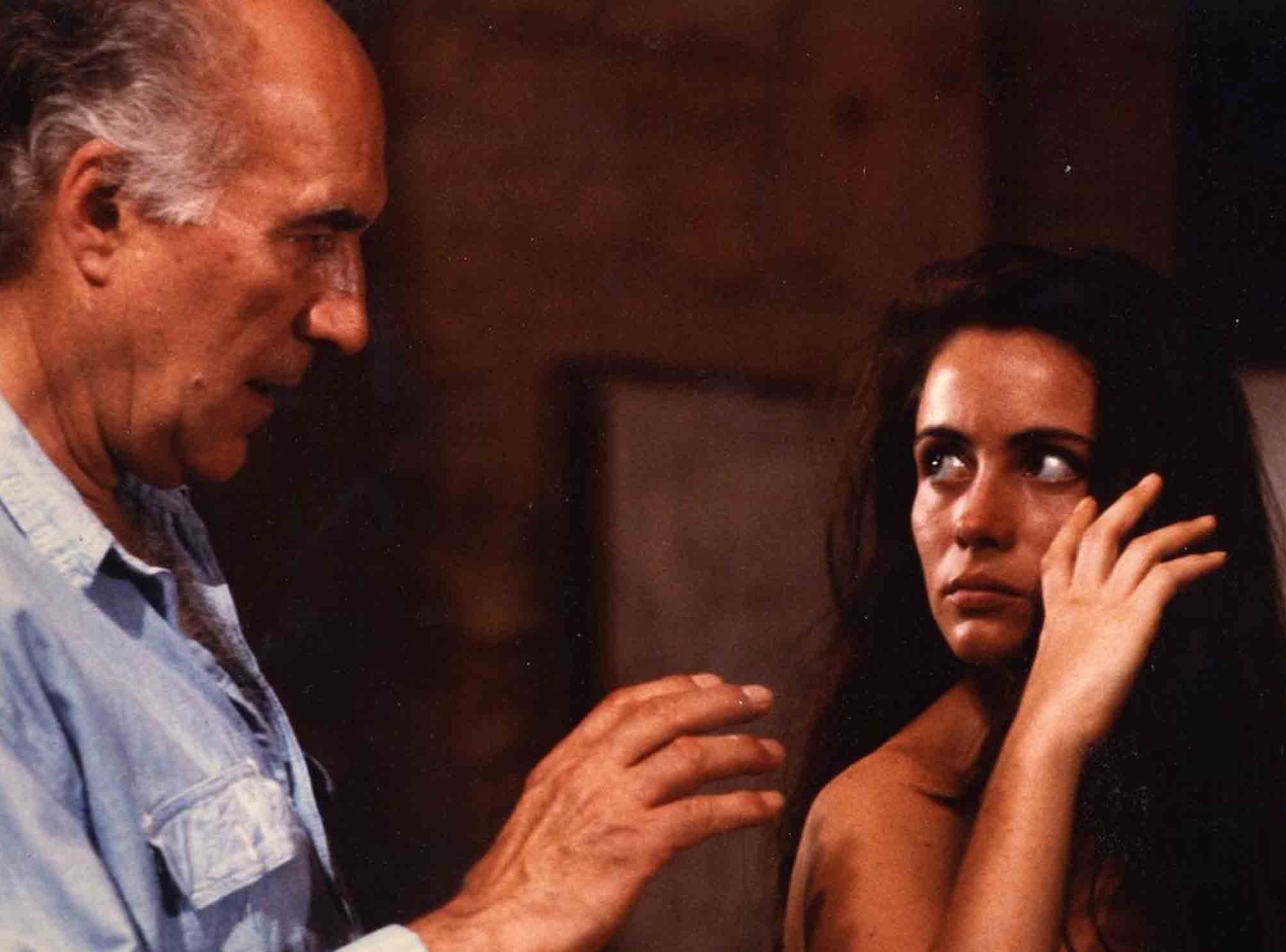
Watching Jacques Rivette’s four-hour drama, La Belle Noiseuse, about a former famous painter attempting once more to create his masterpiece, feels like an important moment for me. I am hesitant to call it ‘life-changing,’ and yet this is perhaps the correct way to put it. Certainly, it feels like a marker in my cinematic journey, a point I will be able to recall, look back upon, note for the way it stands out from everything else I have been watching around this time and for the way it has taken, and likely will take further, my understanding of cinema in a new direction. I suppose what I mean to say is that this film feels like a landmark for me, the end of one chapter and the beginning of another, a point from which my understanding of film will forever be changed. If there are only a handful of films that truly stick with us over our life, that really make an impact and in this way stand out above the sea of other films we watch, then La Belle Noiseuse is, for me, one of those, and joins a collection of other films that include Bergman’s Through a Glass Darkly, Antonioni’s La Notte, and Alain Robbe-Grillet’s Successive Slidings of Pleasure, as well as my introduction to the works of Michael Haneke, Krzysztof Kieślowski, François Truffaut, and Jean-Luc Godard, among others, each of which I find it harder to pin down one specific film of theirs that acted as this ‘landmark,’ but distinctly remember the time when I first began exploring their works. Thus, I feel compelled to write down my thoughts about this film, partly in an attempt to explain why it feels so important to me personally, but mostly as a means of clarifying my thoughts about it, and in order to set forth a more complete understanding of what the film means to me, unguided by any other views or criticisms (since as of yet I have avoided reading other reviews of the film so that I can come to a conclusion of my own, one that reflects my own personal response to it, at its most fresh). The ‘meaning’ of a film is usually fairly unimportant to me. What interests me more is how the film feels during, and after, watching it – what impact it has on me, how it moves me. But with La Belle Noiseuse I feel somewhat different, and that is perhaps down to the way in which the film presents itself and its ideas to its audience. It does this through a slow, gentle layering on of its themes, each scene or moment like a new brush stroke adding a little more of the film’s ideas to its canvas. What is revealed through this by the film’s conclusion are, to me at least, three key elements which I shall explore below: masks and personas; authenticity; and art.
On its surface, La Belle Noiseuse, as I see it, tells the story of a painter (Frenhofer) who has long desired to capture an entire human life in a single painting, but has for a decade or so given up on this pursuit due to its apparent impossibility. He has, in fact, nearly completely given up painting in general, on the grounds that to capture on his canvas anything but this project which he once pursued – which he calls La Belle Noiseuse – would be a waste of his time and would not really be art. Upon meeting Marianne, the girlfriend of young artist Nicolas, however, Frenhofer’s belief in his project is reignited, and he sets out once more to paint La Belle Noiseuse, with Marianne as muse. It becomes apparent, as Frenhofer twists and manipulates Marianne’s body into numerous and increasingly more uncomfortable poses, that what he is trying to capture in this painting is not simply a human body like the various paintings of nude women we have seen leaning against the walls of his studio. Frenhofer says so himself that the body is not what interests him – it is what is beneath the surface, what is inside the body that he is trying to find. His wife, Liz, offers an explanation of just what this means when she speaks of how when a person is drowning it is said that they remember all of their forgotten memories in an instant; effectively a rewording of the common notion that in the moment of death one’s entire life flashes before them. What is suggested here by Liz is that this is what Frenhofer is trying to capture with this painting: he is attempting to not just paint a human being’s physicality and emotion but, as in that instant when one’s life flashes before their eyes, he desires to capture all of this person’s memories and experiences so that, in his single frame (like that single moment before death) he can display an entire human life – a human as a whole, as an entirety, caught within a single painting, a single pose, a single facial expression. I disagree.
At first, this is, indeed, what I believed to be Frenhofer’s goal. Upon a little more consideration, however, a different idea presented itself, and it occurred to me that what Frenhofer desired to capture on his canvas was something that, while similar to this idea of an ‘entire life,’ was also something very different – and perhaps more profound. This other idea, at the very least, seems to tie in with various other parts of the film more than the idea of the forgotten memories. Frenhofer manipulates Marianne’s naked body into various different poses, each one seemingly more difficult for Marianne to hold than the last, and he states that his reason for this is that he is going to break her down, that he is going to break her body apart. He even says that while attempting this with Liz he once dislocated her shoulder. Exhausted, Marianne says that already she can no longer feel her body – good, we’re getting close then, replies Frenhofer. As already mentioned, Frenhofer also lays emphasis on the fact that it isn’t the body that interests him, but that what he’s trying to get at is what’s underneath it. What he also tells Marianne, in what I believe to be a very telling moment as to why Liz’s hypothesis of his work’s aim is incorrect, is that when they are finished with the painting Marianne can return to being who she was before she entered the studio – before he broke her down – if she wishes to. This suggests that Marianne is going to be changed (though not irreversibly) by modelling for Frenhofer, and that this change, whatever it may be, is what Frenhofer wishes to paint. The telling moment in what exactly this change is comes in the final scene when Marianne and Frenhofer, the painting now complete, are in the garden celebrating with the others. In a voiceover at the beginning of this scene Marianne says that she has put back on a mask, though a different mask from the one she was wearing prior to modelling for Frenhofer. Of course she does not mean a literal physical mask, but rather is referring to her persona. And it is this metaphorical mask, this idea of perception, of how we present ourselves to the social world around us, of how we conceal our true selves behind a carefully constructed façade, that I believe both Jacques Rivette’s and Frenhofer’s Belle Noiseuse are fundamentally concerned with.
It appears to me now that Liz was correct in her idea that Frenhofer desires to capture an entire human life in his painting, but incorrect in her conclusion of just what exactly this means. For it is not that the painter wants to try and convey on his canvas what one might see the moment before they die, with every memory and experience and emotion captured in that one frame, but rather he wants to capture a person in that rare, private instant in which they are not wearing a mask, but are displaying themselves as they truly are; when they are wholly themself, and not a single part of them is being constructed for the perception of another. This is the entire human life which La Belle Noiseuse represents. With this in mind, Frenhofer’s insistence on breaking Marianne down, on separating her from her body, makes a lot more sense. The act of fatiguing Marianne physically, so that she can no longer feel her body, so that her body in fact feels like a separate entity to herself, becomes a metaphor for the removal of Marianne’s mask, her persona. Frenhofer, in making Marianne hold this collection of different poses, effectively hopes to crack open the shell which she is wearing, the shell which she has constructed in order to feel safe in society, and in doing so reveal that most sacred thing which lies within it, that being Marianne’s true identity, her whole being. For Frenhofer, one’s persona is inextricably linked to one’s exterior, since it is the mask that one adopts for the perception of others, and these ‘others’ exist outside of one’s body. The persona is a reflection of the external world of a person and the influences acting on them from the society and the world around them, rather than a reflection of the person themself. Therefore, since with La Belle Noiseuse Frenhofer does not wish to paint the persona, but to paint the person beneath this mask, it is integral that he rid of all external parts of his muse – that he breaks open this shell. It is for this reason that Marianne poses nude. Clothes are another part of one’s persona in the eyes of Frenhofer, since they exist on the outside of a person, since, like a mask, they are worn. Therefore, the removal of Marianne’s clothes is the first, and the easiest, step in revealing what lies beneath the constructed shell in which she (like everyone else) lives. The next stage in Frenhofer’s process is, as aforementioned, the separation of Marianne from her physical body, from her shell, which they achieve through physically exhausting Marianne by having her hold the variety of poses that she does. Then there is the third and final step, the most important part of the process, but also the most challenging and potentially frightening.
There is a key moment in the second half of the film that points towards what this step in Frenhofer’s process is, again concerning Liz, in which she warns Marianne that if Frenhofer asks to paint her face, to refuse him. We have seen from the array of paintings scattered around Frenhofer’s studio that he typically does not paint faces – most of his paintings are of women’s nude bodies. There is one exception: an unfinished painting of Liz from when Frenhofer last tried to paint La Belle Noiseuse. Clearly, then, Frenhofer and Liz, a decade prior, arrived at this final step in the process which, I believe, concerns the removal of the mask itself, and thus takes as its focus the muse’s face. Together, they successfully separated Liz from her clothing and from her physical body, and began to work on removing her mask from her face, but something prevented them from finishing the job, and their week of isolation in Frenhofer’s studio did not end with the production of La Belle Noiseuse. Whatever it was that prevented them from successfully removing Liz’s mask clearly troubles Liz still, hence she offers those words of warning to Marianne. Marianne, however, caught up in the excitement of the project, denies Liz’s request and shortly after, her and Frenhofer finally have their breakthrough moment in which the painter believes, at long last, after falling from his stool, that he has caught a glimpse of Marianne without her mask on, free of her persona. And so begins the final section of the film in which Frenhofer constructs his long sought-after masterpiece.
But why is it that Frenhofer is so concerned with removing Marianne’s mask? What is it that lies beneath one’s persona that so captivates him and consumes him that he can’t fathom painting anything else? The answer, I believe, is one that also equally concerns Jacques Rivette: for both painter and director, La Belle Noiseuse and La Belle Noiseuse respectively, represent the search for authenticity. As I understand it, a persona is a constructed identity, a façade created to be perceived by others, a way of fitting into social settings, and is not necessarily reflective of who a person really is. Their persona is their mask. It is their way of hiding the bits of themselves they deem unsuitable for certain social situations. Therefore, one’s persona is never one’s entire self, since they use the persona to hide parts of who they really are. This, then, is why Frenhofer believes that in removing his muse’s persona he becomes able to see their entire being, because there is no longer any part of them that is covered up, hidden away. This is what I meant when I said that Liz is correct in deducing that Frenhofer wishes to capture an entire human life in his painting. But he doesn’t desire to do this by succeeding in capturing every forgotten memory and emotion and experience from his muse’s entire life, but simply by capturing exactly who they are in the singular moment in which he is painting them without their mask on, without a persona hiding bits of who they really are. This person is then the most authentic version of themselves, since there is nothing about them that is being put on for the perception of another. The authentic person lies beneath their persona. This is what Frenhofer is so desirous to capture in his painting, but it is also what he has long believed may be impossible to capture. The reason for this is that, as he proves by the difficulty he has in removing Marianne’s, one’s mask is often so firmly attached that a person can have a hard time understanding which parts of them are their authentic self, and which parts exist solely in their persona. Or, in other words, it can be hard at times to tell which parts of our personality and our identity are really, authentically, us, and which parts exist solely to please others, and thus are not really a part of ourselves. The reason for this, I believe, is that we are afraid of what the world might think of us if it were to see us without this partial disguise, to see us wholly as we really are. And this is why Frenhofer is so interested in capturing this, because it is such a rare instance that someone reveals themself completely. However, I do not believe this is the sole reason that the removal of the mask is such a long and difficult process for Frenhofer and Marianne, and neither do I believe that it is the most important reason. Afterall, the person with whom Frenhofer attempted this experiment with before was Liz, his wife, but they were unsuccessful in fully separating Liz from her persona. Yet if one was to allow anybody to see them at their most intimate, vulnerable, and private, surely it would be one’s spouse? Afterall, Liz was just as keen as Frenhofer to see this project through to completion, so she can’t have been afraid of letting her husband see her wholly authentic self. So what, then, stood in the way?
I believe that what Jacques Rivette suggests, is that the biggest obstacle preventing one from removing their mask isn’t the fear of what the world might think of them, but the fear of what they might think of themselves if they were to see who they really are, with all the dark, hidden away parts of their identity now on show. Liz, I believe, is conscious of this fact, and hence she warns Marianne about letting Frenhofer paint her face. Marianne, however, I believe is naïve to this. I think in her subconscious there is a part of her that is fighting to keep her mask on so that she won’t discover certain things about herself, but I think consciously she is unaware of it. Hence, unlike when Frenhofer tried this with Liz, he is able with Marianne to eventually remove her mask, because she is not consciously resisting – she isn’t aware that she might not like the result. But when he has done so, and when he has painted what he has seen and shows it to Marianne, Marianne promptly leaves the studio without a word, apparently angered, upset, frightened, and perhaps even disgusted by what she has seen. We have seen in the film that Marianne is not totally happy, that she seems perhaps dissatisfied in her relationship with Nicolas, and with life in general, but despite this she puts on a happy face and seems to brush most of it under the rug. I think Frenhofer notices this, and this is why Marianne appears to him to be the muse he has been looking for. While in his studio, we learn more about these troubles of Marianne as she opens up to Frenhofer about her awareness that she will lose Nicolas to his artistic pursuits. It seems to me that this gradual opening up of hers coincides with the gradual removal of her mask, as her genuine, honest, authentic self is revealed more and more each time she comes back to model for Frenhofer. I think there is a lot about Marianne that remains undisclosed, though, parts of her identity and her history that are hinted at in moments such as during her interactions with Nicolas’s sister, but never fully expanded upon. I think these are the dark sides of Marianne’s personality, the parts she usually keeps hidden away behind the persona she has adopted to cope with her dissatisfied life and to appear happy and fulfilled to both those around her (such as Nicolas) but also, more importantly, to herself. I think Marianne’s persona exists in large part to deceive herself into thinking that she is fulfilled with life: she’s a writer; she’s dating the man she loves, a painter who by all accounts is destined to be very successful; and the two of them seem financially secure. Parts of her life such as these are used in the construction of her persona to keep hidden from herself the fact that she isn’t satisfied with the direction her life is taking, and to make her forget what really, deep down, she knows is the most likely outcome for her and Nicolas – that he will fall deeper and deeper into the pursuit of his art, that because of this he will come to neglect her, and she will leave him as a result. These are some of the true feelings she harbours behind her mask, and these are part of her authentic self which, to her horror, are revealed to her by Frenhofer’s painting, La Belle Noiseuse, ‘the beautiful troublemaker.’ Coming face to face with her real feelings, her real identity, is not a pleasant experience for Marianne. In fact, it appears that she is horrified by what she discovers, the parts of her that either she didn’t know existed, or was once aware of but has hidden away so well that she had forgotten about them. And I think there is a sense of shame that these ‘undesirable’ (to her at least) traits exist within her, and that they have been seen by Frenhofer. She spends the rest of that day and evening trying to forget what she has learned about herself, hiding herself away in the bathroom with the taps running, we assume as a way of drowning out the thoughts and the images that must be consuming her.
This reaction of Marianne’s to the discovery of who she really is, combined with her decision upon leaving the studio to put a mask back on, as she informs us in the final scene, instead of re-entering the world with her authentic self on display, contains the hugely powerful and unsettling revelation that I believe the whole film has been building towards. What I believe Rivette suggests, is that we spend our lives attempting to uncover the real us, to discover who we really are, to find our purpose in life, to see where our originality lies and what our true feelings and thoughts are, but if we could ever succeed in doing this wholly, if we were to ever be presented with the entire version of ourselves, with a complete answer to the question ‘who am I?,’ – if we were to come face to face with our own Belle Noiseuse – could we really bare it? Or, like Marianne, would we prefer to put a mask back on and cover back up some of those parts of ourselves – the cold and the dry parts, as Marianne describes them – that we would prefer not to know exist within us? The idea, I suppose, is do we choose truth and authenticity, or do we choose comfort? For as we see in Marianne’s reaction, being faced with the authentic can be very far from a comfortable experience.
There is also another, related, idea that lies a little further in the background of the film, that isn’t given as much attention by Rivette’s camera, but which is perhaps even more unsettling than the idea of being confronted with an image of ourselves without our mask on. It is, once again, the character of Liz who offers up this idea, this time through the interactions and conversations she has with her husband, Frenhofer. As we have previously noted, Frenhofer originally embarked on his project La Belle Noiseuse with Liz as his muse. They were, however, unable to complete it, giving up before Liz’s authentic self was fully revealed. Earlier, I mentioned that this might have been due to Liz resisting Frenhofer’s attempts to remove her mask out of a fear of what she would learn about herself – after all, there is the warning she gives to Marianne about letting Frenhofer paint her face, which points towards this theory. However, I wonder at another theory, which is the possibility that the blame for their giving up on the project lies not with Liz, but with Frenhofer. We are actually shown the painting that came out of Frenhofer’s and Liz’s failed attempt to create La Belle Noiseuse, just before Frenhofer paints over it with one of his paintings of Marianne. Liz is upset at discovering that Frenhofer has effectively erased the painting of her, and she expresses this to her husband, who appears to feel no remorse; he says that he wants to forget that time, and thus it was necessary that he paint over Liz’s face. What we learn from this is that while Frenhofer greatly dislikes the unfinished portrait of his wife, his wife, in fact, has a great affection for it. This, it seems to me, suggests that Liz is not disturbed or frightened by what is revealed about her in this portrait, or at the very least is less disturbed than Frenhofer is. Now of course their attempt at La Belle Noiseuse was unfinished, and so what we see is not the completely authentic Liz – she had her mask, her persona, still at least partially intact, partially attached. However, I do believe that what is hinted at by their discussions about that week from which this portrait emerged is that they had started to remove Liz’s mask, that her authentic self had started to become visible. But then they stopped before they got the whole mask off. Why is that? I can only speculate, as the film offers no definite ideas, but what is suggested to me is that they stopped because Frenhofer was frightened by what he was starting to discover about his wife. As mentioned, Liz seems to like the portrait they created, whereas Frenhofer is apparently haunted by it so much so that he must paint over it. What’s more, in any conversations the couple have regarding that week when they attempted to create La Belle Noisesue, it comes across that Liz has only fond of memories of it while Frenhofer prefers not to think of it. On top of this, we learn that Liz is saddened by the fact that since that time Frenhofer has ceased to paint her at all – she used to be his primary muse. What all this implies to me is that Liz was not only the more eager of the two to create La Belle Noiseuse (and thus to uncover the real authentic Liz), but that she is also still desirous to finish the project to this day. The fact that Frenhofer refuses to paint Liz anymore, and the way in which he is clearly haunted and disturbed by both the incomplete painting of Liz and the memories he has of creating it, suggest that it was he, not Liz, who called a halt to the project, and that the reason for this was perhaps not because it was impossible to remove Liz’s mask, as I previously suggested, but because Frenhofer was scared to do it. It seems that the little glimpse that he caught of who his wife is behind her persona disturbed him enough that he preferred to leave her persona intact than complete his life’s ambition of painting La Belle Noiseuse. This, to me, is perhaps an even more unsettling idea from Rivette than what he presents to us through Marianne, since through this relationship between Frenhofer and Liz we are shown that even love may be primarily based upon falsity, that there is a chance that it is a person’s persona that we are in love with, and not the person themselves. Is this what Frenhofer discovered while painting Liz, and what he has kept hidden from her as the real reason that he stopped the project? If so, then Rivette leaves us with a conundrum perhaps even more unsettling than what we were confronted with by Marianne’s reaction to seeing her authentic self: is it possible to love another completely? or does love cease at the level of our personas? And if the latter, do we abandon love in the knowledge that a person is fundamentally unlovable, or do we choose to love regardless, turning a blind eye to the reality that the person we love is not really who we believe them to be? The answer Frenhofer seems to have settled on is to love regardless, and yet there remains in his and Liz’s relationship a certain uneasiness, as though things have never quite been the same between them since that week in which they attempted to create La Belle Noiseuse.
As well as these questions of identity, personas, and love, Frenhofer’s abandonment of painting Liz, and of painting in general, offers up another intriguing idea concerning authenticity, this time centred around art. As aforementioned, after failing to create La Belle Noiseuse in the past, deeming it a near-impossible endeavour, Frenhofer not only gives up on this project, but he practically stops painting at all, retreating from the limelight in which his fame had placed him, and painting only very occasionally a self-portrait, and even then for his eyes, and maybe Liz’s, only. Why is this? It is not due to a severe knock of confidence in his abilities – Frenhofer is well aware that he can paint well; he has numerous paintings in his studio, and presumably a large number of pieces around the world that he has sold. Rather, it appears that he doesn’t desire to paint anymore because he no longer has an interest in any project that isn’t La Belle Noiseuse. It seems the style of paintings that once absorbed him and which made him famous, namely nude portraits, can no longer satisfy his artistic hunger. But this, I believe, is not simply due to boredom because he has painted works in this style for so long. Afterall, if that were the case, Frenhofer could very easily simply embark on a new style of painting and flog these projects to the art market. Rather, I think the issue is that Frenhofer knows that any painting that he creates now won’t really be art. The reason for this is that these paintings are not what he genuinely wishes to create, and as such they can not contain an authentic expression of his. Prior to the idea of La Belle Noiseuse, the portraits which Frenhofer painted were authentic expressions of his artistic self, since these portraits were what inspired him, they were what he genuinely wanted to create. Thus, they can be, in Frenhofer’s eyes, classified as art, because their creation was founded in genuine, authentic artistic discovery. These portraits, during that time in Frenhofer’s life, were what he felt he needed, as an artist, to create. But since the idea of La Belle Noiseuse came to him, these portraits are no longer what he really desires to paint. Therefore, to paint them would be simply to go through the motions, to paint for painting’s sake – to appease the market who know Frenhofer for such works, and desire more works of the same style – rather than creating a piece of work that he truly wants to create. Thus, Frenhofer views such pursuits as inauthentic, and by consequence he does not deem them art. There is a clear and inextricable link for Frenhofer between authenticity and art. For him, art must be an authentic expression of the self, and not a creation made for others. In this way, Frenhofer’s view of what constitutes art becomes a very similar notion to the idea of the authentic self versus the persona, where a piece of work created as a result of a genuine, authentic artistic need can be deemed art (a person’s authentic identity), while a piece of work created for other reasons, such as to sell, or to appease somebody, cannot (it is a persona). It is for this reason that Fremhofer has given up painting, because he knows that anything he creates won’t be authentic, and therefore won’t be art. That is until Marianne comes along, and he is presented with the opportunity, once more, of painting what he really wants to paint. La Belle Noiseuse, then, is not only an expression of authenticity in its finished form, as it captures Marianne without her persona, but in fact long before it is completed it is already an authentic piece of work, as it reflects Frenhofer’s true artistic aims, and in this way La Belle Noiseuse is a reflection of not just Marianne’s authenticity, but of Frenhofer’s, too, and also of what it means to classify something as ‘art’ at all.
It is significant, then, that after completing La Belle Noiseuse, Frenhofer does not show it to the public. Instead, he places it in a recess in his studio and builds a wall in front of it, sealing it in a sort of tomb where, for as long as he is alive at least, it shall remain, unseen, unknown. The only eyes that have seen it are his, Marianne’s, Liz’s (though unknown to Frenhofer), and Magali’s (who helps him to build the wall). Importantly, Porbus, the art collector who introduced Nicolas and Marianne to Frenhofer, never sees the painting. Before Frenhofer began the project afresh with Marianne, Porbus had already stated his desire to buy the painting once it was finished. For Porbus, authenticity is not important in art. He desires to own Frenhofer’s masterpiece not because he likes it (he offers to buy it before the project has even begun), nor even because of its artistic value, but simply because it is, supposedly, Frenhofer’s masterpiece. For this reason, Frenhofer cannot let Porbus see the finished result, let alone buy it, as this would defeat the purpose of its being created. La Belle Noiseuse was created to express Frenhofer’s authentic artistic expression, and not to be sold and added to somebody’s collection. Were it to be seen by and sold to Porbus, La Belle Noiseuse would lose this authenticity, for it would, then, have in part been created for somebody else, for reasons other than Frenhofer’s authentic ones, and thus could no longer be classified as art. It is for this reason, too, that the audience of the film never sees the finished painting either. Jacques Rivette is equally aware that we, his audience, are in the same position as Porbus, that were we to see the painting then it would reduce its artistic integrity as it would now have been created for us. Instead, it remains only an authentic expression of Frenhofer and Marianne, not to be seen by any other eyes than those. What Frenhofer does show to Porbus and the others is a fake Belle Noiseuse which he quickly creates in the same night that he walls up the real painting. This fake, then, acts as the real painting’s persona. Frenhofer is aware that, like a person’s authentic self, a piece of art’s authentic self is not suitable to be shown to the world, least of all to the consumerist part of that world, represented by Porbus. As a result, he creates a mask for La Belle Noiseuse, so that the authenticity of the real artwork can remain safe, hidden, preserved. With this ending, Rivette calls into question the authenticity of much of what we call ‘art’, since so much of what is created is done so primarily for financial reasons or for entertainment. In the eyes of Rivette, like Frenhofer, such works cannot really be classified as art, as what we are being presented with is more akin to a person’s persona than to their real authentic self.
To conclude, then, La Belle Noiseuse, through the gentle, hypnotic experience that it absorbs us in, offers a powerful insight into questions of authenticity and art. A lot of what is presented to us is left for us to dissect ourselves, so that we can reach our own conclusions as to what the answers to these questions are. Even though Frenhofer may well be a representation of Rivette himself, the director does not suggest that the ideas expressed by Frenhofer are the correct answers. Very likely such questions have no ‘correct’ answer. What we are left with is a film of immense beauty and subtle power, and the suggestion that if there is to be found an answer to the question, ‘who am I?,’ then this answer is to be found, most assuredly, within art, but that we must be prepared for the very likely outcome that the answer that we hope to find will not be the answer with which we are greeted. Perhaps art, and only art, can reveal our true selves to us, and even then, fortunately for us, perhaps only for the most fleeting of moments.
April 8, 2025

 benedicthutchinson.com