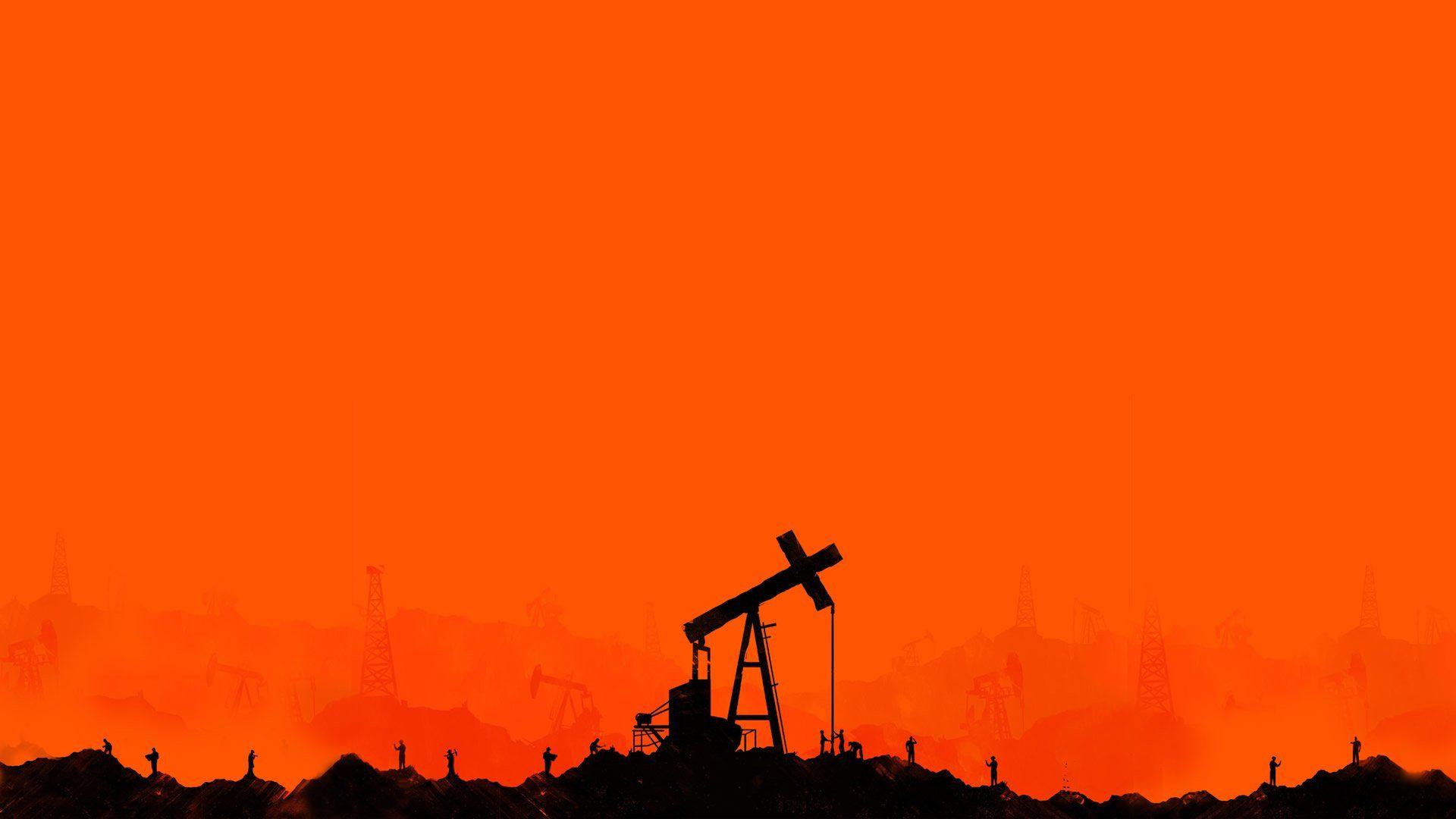
Greed, power, envy; it seeps into every nook like oil. It may spread slowly, but it will stain all it touches black, and, uncontrolled, it will keep trickling and trickling, covering an ever-wider surface, seeping deeper into the cracks. Family, friendship, faith – all will be marred. As hard as one tries, as far as one runs, no-one, and nothing, will stay clean of it forever. Its reach is limitless. It corrupts. It destroys. It kills. Friends will turn on friends; lovers on lovers; the self upon the self. And at some point, in the end, inevitably…there will be blood.
Paul Thomas Anderson’s highly revered slow-burn drama about a ruthless oil prospector in California at the turn of the twentieth century is, for me, a masterclass in metaphor, symbolism, and thematic presentation. Rarely have I seen a film that, throughout its entire runtime, sustains a singular metaphor so well, or manages to fill every scene with its core themes without them ever feeling overemphasised or dull. And rarely, if at all, have I seen a final scene work in quite the way that the scene does in the finale of There Will Be Blood. Upon starting this, my second, Paul Thomas Anderson film, I feared I may be underwhelmed due to the praise that I know surrounds it; it has garnered an almost unheard of 4.5/5 on Letterboxd, and seems to have attained the status of a bit of a modern great. But, thankfully, my hesitations were unjustified.
There was, however, a moment in the middle of the film when I felt that Paul Thomas Anderson wasn’t achieving the heights he desired to with this epic period drama. Daniel Plainview (played by Daniel Day-Lewis), and his newly reacquainted half-brother Henry (Kevin J. O’Connor) are sat on a beach recounting stories from their childhood together. The imagery is dreamlike with its lens flares and the shots of Daniel Day-Lewis bobbing around in the sea. But within these dreamy shots, as the half-brothers talk about their plans for the future and reminisce on the past, we catch Daniel’s mood shift slightly in reference to something that Henry says, and though it lasts only a fleeting moment, we sense distrust, a fear of losing power, and we predict a betrayal or a potentially violent end to their relationship is on the horizon. This moment made me think of The Godfather. Thematically, at this moment in There Will Be Blood, the two films aligned as it appeared that the central themes being presented by Paul Thomas Anderson were, like Coppola’s epic crime saga, family and love, and how these are threatened and corrupted by ambition and power. Combined with the slow-burning tension, bold set pieces, lengthy runtime, and the timeframe that covers several years in the life of the its characters (two and a half decades in the case of There Will Be Blood, and a decade in The Godfather), it felt like Paul Thomas Anderson was trying to make his period drama an epic on the same scale as Coppola’s. The trouble was, Paul Thomas Anderson’s film was not achieving this as effectively as The Godfather for me; the film wasn’t delivering on its emotional level to quite the same extent. The rise of Daniel Plainview, his power and ambition and the consequences this was having on his family and in his personal life, was far less impactful to me than the rise of Michael Corleone and its similar consequences. So, for a time while watching There Will Be Blood, I felt that this was simply going to be a very well-made film that couldn’t quite reach the heights it wished to reach – the heights of its predecessors. In short, I thought it was going to be very good, but not great. Of course, I was mistaken.
So why write about this moment of doubt in the first place? The reason is that this doubt was caused by a misconception I was holding of what the film was trying to be and trying to do. In using this misconception as a contrast to the film’s actual aims, I hope it will be easier to examine what it is that There Will Be Blood does so well. And to do so, we must turn to the film’s final scene, for it is here that everything becomes clear. Unlike The Godfather, There Will Be Blood is not a character study of a man’s rise to power and the slow but sure corruption of his self that takes place along the way – which is what I thought it was trying to be for a time. This is a theme within the film, certainly, and Daniel Day-Lewis performs this part magnificently. But this is not the central motif operating on the film’s emotional level; it is not the film’s pulse; it is not the film’s heart. Hence, the actions which lead Daniel Plainview to his ultimately pitiful end, as ruthless as they are, do not inspire the same powerful emotional response as say – to keep on using this example – those of Michael Corleone in The Godfather. Afterall, we never really get to know Daniel Plainview before he has begun to succumb to his ambition and greed – the man we meet is one already infected by these vices. In contrast, Coppola presents Michael Corleone to us as a caring partner to his girlfriend, and as somebody uninterested in – even reluctant of – getting involved in the nasty affairs of his family. Hence, Michael’s character arc becomes – at least for me – the central emotional level of the film, while Daniel Plainview’s does not. And it was in believing that Daniel Plainview’s arc was supposed to be the core emotional vehicle of the film that I was led to the feeling that There Will Be Blood was not as successful an ‘epic’ as it hoped to be. Then came the final scene.
It is during this scene – which feels almost like a coda – as Eli the preacher finally, desperately, sells out his beliefs, and Daniel Plainview explodes at him in a fit of triumphant rage and hatred for both Eli and himself, that, like Daniel’s rage, the film’s intentions, its symbolism, its core, burst violently, spectacularly onto the surface. In this moment it becomes clear that Daniel Plainview was never what this film was about. His might be the story which guides us through the film, but his steady succumbing to greed and power – which takes hold of him like a disease – is but a consequence of what really runs through the film’s core: oil, and everything that Paul Thomas Anderson has it represent. Greed, power, and envy are of course three of the key themes in There Will Be Blood symbolised by oil, and these are presented most clearly through the character of Daniel Plainview. Each represents a consequence of the capitalist society under criticism by Paul Thomas Anderson, with Plainview the central example of how each works upon a person to corrupt and destroy them. We witness as Plainview first discovers oil and how he is immediately consumed by the possibility of the wealth this could bring him, so much so that the death of one of his workers during the discovery doesn’t phase him, and without a second a thought he adopts this worker’s now-orphaned son not out of kindness or a sense of duty, but as a means of bettering his chances of success (which he finally reveals in the film’s penultimate scene). The more oil and oil-rich land that Daniel goes on to amass – the more wealth he accumulates – the greedier and hungrier for power he becomes, and the greater the envy and jealousy that grow within him of the success of others. Wealth and material success turn him paranoid as he is scared to lose what he has already begotten, and his ambition for more only continues to grow and grow. We are shown that such ambition and wealth lead not to a happy life, but to the opposite, as Daniel Plainview’s paranoia and hatred of others grows to such an extent that he ends the film living alone in a huge mansion, isolated from everyone including his adopted son. He has also become an alcoholic, a disease which symbolises perfectly here the disease-like nature of the capitalist system which infected Daniel’s mind with thoughts of power and wealth. It was of course oil which ultimately gave fruition to these desires, and like how spilled oil will spread and seep into the cracks of the surface it is on and stain it all black, so the greed and envy, which came as inevitable consequences of the wealth and power promised to Daniel by the discovery of oil, have seeped into each and every vain of Daniel’s by the film’s end. Likewise, the film’s ending presents Daniel as a man sick from the alcohol that, similarly, courses through his veins. Thus, alcoholism, like oil, comes to symbolise capitalism, and both oil and alcohol are symbolic of the way in which greed, envy, and power – consequences of this capitalism – seep into a person and corrupt and destroy them.
Oil is used symbolically throughout the film for this purpose – as a metaphor for capitalism and the affects this societal structure has on the people who inhabit it. Perhaps the most glaring consequence of the discovery of oil in the film – outside the personal self-destruction of Daniel Plainview – is the destructive affects it has on family. Early on we meet Eli the preacher’s identical twin brother, who makes no bones about selling information to Daniel Plainview regarding the location of the oil rich land upon which his family live. He does this behind his family’s back, pocketing the cash for himself and then disappearing, leaving his family to pay for the consequences that this action will bring to their home and to their town. The family is further torn apart upon the arrival of Daniel Plainview to Eli’s family home and his subsequent purchasing of the family’s land. Eli is distrustful of Daniel from the start and sees that Daniel is cheating them by offering such a low price for the land. Nevertheless, Eli’s father agrees to the deal, and in doing so he hands Daniel the power to start mining for oil. As Daniel’s success grows, and his power increases, the town becomes increasingly more dangerous and less peaceful. Townsfolk who now work on the oil rig are injured and killed while at work; Daniel’s control over the town strengthens; and more and more people become stained by the oil that is being unearthed. As Eli witnesses this all, powerless to stop it, his patience wears out and he finally flies at his father in a fit of rage for allowing it to begin in the first place. Finally, we have Daniel’s adopted son HW’s maiming as a result of an explosion on the oil rig, and his subsequent abandonment by Daniel as he is sent away on a train so that Daniel has one less distraction between him and his ambition. Thus, throughout the film, Paul Thomas Anderson makes it clear that even the tight bonds of family are not enough to withstand the temptations of oil and the corruption that it spreads. Oil creates money, and the thought of this money is enough for Eli’s twin and Eli’s father to sell out their family, and for Daneil Plainview to give up his son.
But the final and most devastating affect that capitalism (in the guise of oil) has, is only revealed in the film’s final scene. It is 1927 and Eli the preacher has recently returned from missionary work in foreign lands and comes knocking on the door of Daniel Plainview. It isn’t long before he reveals that he and his hometown are suffering as a consequence of the Great Depression and he wishes for Daniel to partner with him in drilling oil from an area of land that Daniel never previously succeeded in purchasing. Daniel agrees to help, but on one condition: that Eli denounces his faith. And it is in the moments that follow that the pulse, the heart, the core emotional and thematic level of There Will Be Blood reveals itself. Although at first he refuses to denounce God and Christianity, Eli’s desperation gets the better of him and he cries over and over again that he is a false prophet and that God is a superstition. In doing so, Eli, the one person whom we thought had managed to remain clean of oil and the envy, greed, and desire for power that it poisons people with, is shown to have been corrupted just like everybody else. Despite travelling far away on his missionary work, these vices managed to infect him – capitalism’s reach knows no bounds, no borders. Eli has been, throughout the film, a symbol of the human soul, not only because of his role as preacher, but more importantly because of his constant rejection of Daniel Plainview and his ruthless hunt for oil. That is until the final scene where, in selling out his beliefs in hopes of a taste of Daniel Plainview’s success, Eli symbolises how the soul, one’s humanity, becomes stained and corrupted by capitalism. He is then subsequently beaten to death by Daniel Plainview in a fit of angry revenge, a metaphor for the inevitable death of our soul under capitalism as a result of the vices with which it infects people, which run through us like oil through a pipe, replacing generosity, selflessness, and comradery with greed, envy, and a selfish and ruthless desire for prosperity. Thus, the final scene works to bring to the surface – in the same way that Daniel Plainview brought oil to the Earth’s surface – the core theme of the film: the death of our humanity under the capitalist system we created. Paul Thomas Anderson very pessimistically shows that the two cannot go hand in hand, for capitalism’s corrupting effects are too powerful to be withstood by the human soul.
As this thematic level to the film exploded onto the film’s surface, I realised that this was what There Will Be Blood had been about the whole time. Oil, as I have mentioned several times, is symbolic in the film of capitalism, and capitalism, especially in the final scene, is shown to be a destroyer of our humanity. Throughout the film, whether in sight or not, oil is always present. If it isn’t exploding out of the ground, or being collected in a pool, or staining the characters’ hands and faces and clothes black, then it is lying dormant under the Earth’s surface, or running through an underground system of pipes, hidden from our view, but very much present, very much influencing the decisions of the characters. For almost the entire film it lies here, out of sight, like the blood in our veins – it is the blood of the land. And like blood, it is what gives life to the film. This thematic and emotional level of the film has been with us throughout the film’s runtime, even when we weren’t aware. It has been the film’s pulse. And this fact is what is so amazing about the film’s final scene and the film as a whole. The final scene doesn’t add this thematic and emotional level in a last desperate attempt to get a reaction from the audience. Instead, it works, like Daniel’s oil rigs, to bring to the surface what has been beneath it the whole time. The emotional and thematic level that have been at the film’s core guiding each and every scene, unseen, explode onto the surface. All the tension, emotion, and violence that have been steadily building in pressure over the film’s runtime, and the blood that the film’s title promised us we would see, finally bursts onto the screen with the same energy that the oil burst out of the ground earlier in the film when Daniel first drew it fourth in Eli’s hometown. In this way, the way in which the film is structured comes to be a metaphor for the prospecting and drilling of oil itself, so that oil influences not only the actions of the film’s characters, and the themes and metaphors of the film, but also the way in which this story is told and the effect that it has on an audience. Thus, the film’s central trope (oil) and the capitalism which it symbolises, can’t help but fill each and every scene of this epic, since its roots burrow deep into the film’s story and also the decisions influencing how exactly that story is going to be presented to its audience.
In structuring the film in this way, Paul Thomas Anderson presents capitalism as having complete and total control over our lives. At first, we believed that capitalism was merely the focus of the film, contained safely within its plot and effecting the lives only of the film’s characters. But the final scene – in revealing how the film’s structure mirrors that of oil prospecting and then oil drilling – shows that capitalism is much more than the film’s focus. Capitalism is not contained neatly within the boundaries of the plot, but in actual fact it is the boundaries. Capitalism is the film’s structure, its outermost edge, and by allowing this to be the case, Paul Thomas Anderson emphasises how inescapable, and how powerful, this social system is, and he makes There Will Be Blood a masterclass of metaphor and symbolism, and a very fine example of the power of storytelling.
February 5, 2025

 benedicthutchinson.com