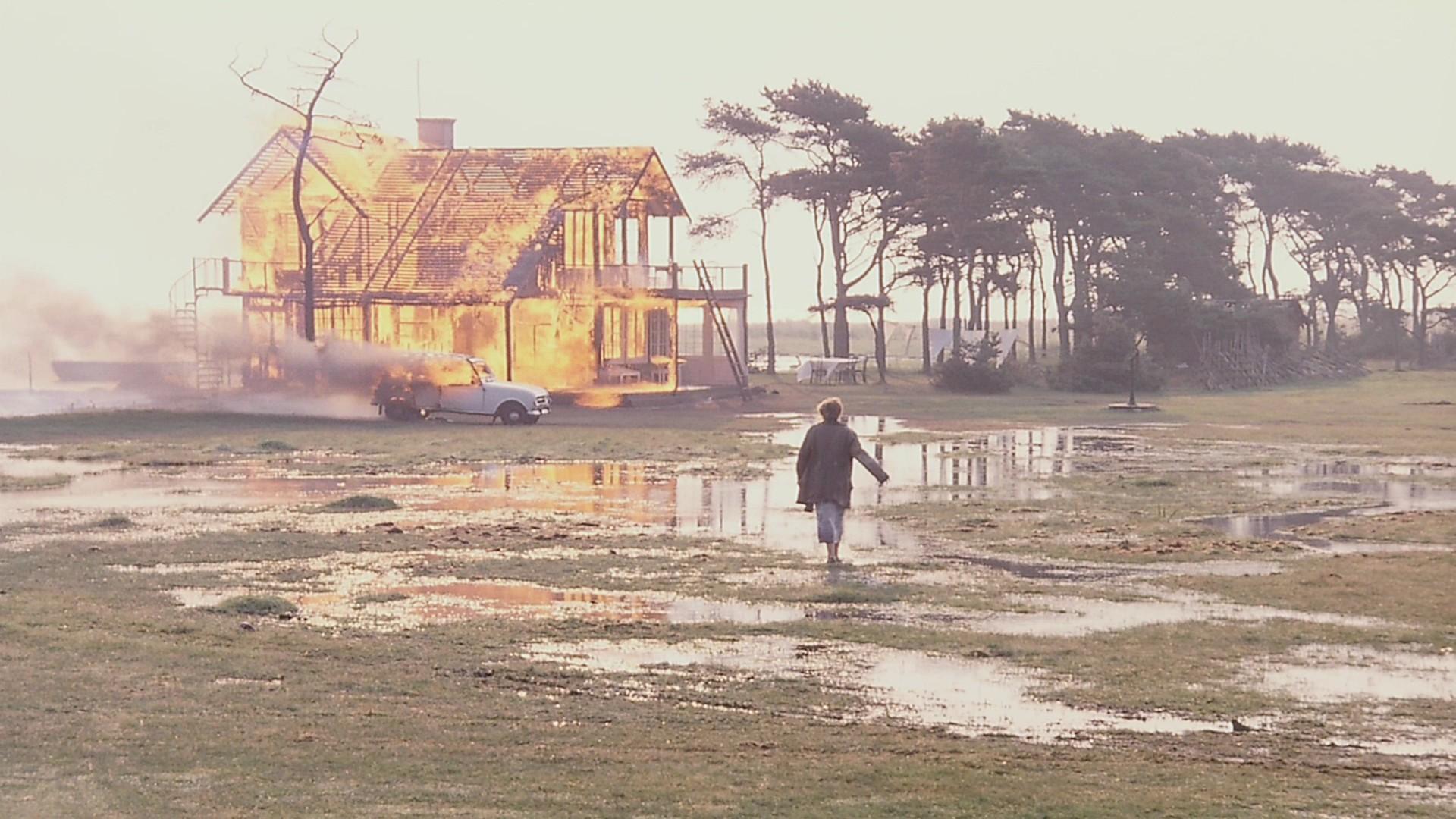
Having just watched The Sacrifice, I feel compelled to write of my experience with the films of Andrei Tarkovsky so far – and so my other thoughts can take a backseat for the present. I have now seen four of the Russian filmmaker’s pictures: Stalker, Mirror, Nostalgia, and The Sacrifice, in that order, and each has the rare quality that, upon reflection after viewing it, it feels as though I didn’t watch a film, but rather dreamt it. Another example that had a similar effect on me that comes to mind at this moment is Alain Resnais’s and Alain Robbe-Grillet’s Last Year at Marienbad, a film with a similarly hypnotic, trance-like tone to the films of Tarkovsky, but with a more overt surrealism than we see in the Russian’s work. But I think what I’ve realised – as a result of watching The Sacrifice and subsequently having Marienbad put back on my mind – is that Tarkovsky’s films are in fact every bit as surreal as the works of say Buñuel, Robbe-Grillet, or Godard, but his approach to it is different, and the result is that the surreal in a Tarkovsky film comes to feel very real.
Something notable about my viewing experiences of Tarkovsky’s canon is that without fail I have been unable to remain awake for the entirety of any of his films, instead drifting in and out of a half-sleep. But this is not a criticism of Tarkovsky, far from it. In fact, it’s one of the elements of his films that so enchants me, and so before delving further into these films I wish to explore a little just why that is. I’m not drifting into sleep out of boredom, which is what one might commonly assume to be the cause of lethargy while watching a film. If I find a film tiresome or boring, or feel it is dragging or has too lengthy a runtime, I become quite the opposite of sleepy; I feel agitated, restless, frustrated. This is how I felt during a recent viewing of Godard’s Weekend, in fact, though I don’t intend to criticise Godard here as his films typically inspire me greatly and there is a chance I simply wasn’t in the mood for Weekend that day. My point is, I didn’t drift off during The Sacrifice because it was a tedious watch. It was because, like Tarkovsky’s other work, it is mesmerising, hypnotic, and calming. The whole atmosphere of his films is like an ocean of calm washing gently over you, sweeping you softly up in its world and carrying you with it for a journey so comfortable, so dreamlike, that you can’t help but occasionally drift off. For me, it’s a similar experience to when I’m a passenger in a car and I feel a song has been playing forever as though time has finally slowed down enough for me to really be able to appreciate everything, only to awaken and realise that a different song is currently playing, that the song I thought I was hearing finished a long time ago, and that my half-awake-half-dreaming state had led me to believe that I was here in the moment when in fact I was way off someplace else far away in my head. That’s the sort of experience I have watching a Tarkovsky movie. It’s a blurring of time, so that you are unsure how much time is supposed to have passed in the world of the film’s characters, and you lose track of any idea of how much time has passed in the real world.
This playing with our perception of time is a notable trait, I think, of each of the Tarkovsky films I have seen so far, and it figures as such given that memory is a key theme throughout his canon. Something that Tarkovsky achieves so well with film is demonstrating how time can feel very far from linear, how our memories and our perceptions and our ideas and thoughts and hopes and fears can blend together the past, the present, and the future so that is unclear which we are living in at any one moment. If our memories of past events or people still act on us, still impact or change who we are or what we do, then are those past events really in the past? Or are they now a part of the present? This seems to be a question Tarkovsky toys with, and one he puts across visually so effectively. When a character reflects upon a past action or a past relationship, say, we don’t witness this play out in a flashback of them ten years ago, or them as a kid. Instead, Tarkovsky has the character experience this memory within their present situation. Their current location becomes the location within which the memory presents itself, so that the present situation is mixed with the past, becoming a new sort of space and time entirely. We see neither an ‘accurate’ representation of the past nor an ‘accurate’ representation of this present, instead seeing the character make their way through a new, strange world where everything is both familiar and yet unreal. We see this take place particularly in Nostalgia as Andrei Gorchakov loses himself within his memories of Russia as he journeys through Italy, and so moments from his past become intertwined with his present in such a way that it becomes unclear for both him and for the audience what is being experienced in the here and now, and what is a memory of a past experience. And this is the point, of not just Nostalgia but of each of Tarkovsky’s works. They all seem to play with the philosophical idea that our perceived notion of something -whether a person, an event, an object, or a memory – or in other words our subjective, internal experience of something, is just as real as the objective, external reality. So, while an outsider observing Gorchakov might only see a man walking through the room of a house in Italy, and so that could be said to be the ‘truth’ of the situation, the ‘truth’ for Gorchakov is very different. Within this room of this house in Italy he sees objects and people from his past in Russia, and these play on his mind to such an extent that he experiences the room in a different physical state and in a different light, and the dripping water appears much louder to him than it would to an onlooker. His experience of this house, then, is very different to that of somebody else because it is altered by his internal emotional and mental state. For Gorchakov, his present moment experience becomes very much entangled with his past, and thus, since Gorchakov’s experience of the situation is suggested to be just as valid as an objective onlooker’s experience might be, Tarkvsoky is implying that the line we draw between the past and the present is by no means as clear nor defined as we typically tend to think.
So how does Tarkovsky manage to make these very subjective experiences appear true almost to the point of seeming objectively true, instead of having them come across as fantasies or delusions, and without presenting his characters as people in mental collapse? The answer, I believe, ties in nicely with the main topic of this essay: Tarkovsky’s thorough but disguised used of the surreal. To begin, I think we need to examine briefly how and when the surreal has been implemented in films since the surrealist movement of the 1920s, as this will give a clearer picture of how Tarkovsky’s use of it differs to the norm, and in turn how this contributes to his signature presentation of the subjective experience. Surrealism as a cultural and artistic movement rejected logic in favour of the illogical that arises when expression is given to the unconscious mind. Thus, surrealist cinema often embraces dreamlike logic and visuals, whereby events play out without any chronological or geographical order, images are often shocking and in juxtaposition with one another, and rational explanations for the drama that occurs appear non-existent. The result is that the world is presented as without cause-and-effect; it is irrational and nonsensical. This style has been used both to criticise bourgeois society and its conservative notions of logic and of objective truth (notably, for me, in the films of Luis Buñuel and Jean-Luc Godard), as well as to help depict the psychological state of characters in mental decline (think Darren Aronofsky and David Lynch). In both instances, the aim is to present the world as illogical and irrational, whether that be to highlight the flaws and absurdities of bourgeois life, or of post-war life, or to show the confusion and fear experienced by a character whose subjective view of the world appears to be becoming ever more untrustworthy and at odds with the objective world around them. Because of this aim, surrealist films tend to confuse, alienate, and/or frighten their audiences in order to either create sympathy with a character who is losing touch of reality (Natalie Portman in Black Swan, Naomi Watts in Mulholland Drive), or to create a lack of sympathy for characters (or a whole society) who are out of touch with reality due to class/social standing/ignorance (The Discreet Charm of the Bourgeoisie, That Obscure Object of Desire, Weekend). This is where a Tarkovsky film differs from the norm in its use of the surreal. While Tarkovsky uses familiar surrealist tropes, such as: a lack of clear chronology; objects and people in places we wouldn’t expect to find them; and sequences of atypical human behaviour, the way in which he implements these tropes is different to that of the more blatant surrealist filmmakers, and as a result the effect that a Tarkovsky movie has on its audience is very different from that of a Buñuel or an Aronofsky. Instead of presenting the surreal as chaos and disorder, Tarkovsky maintains his signature slow, meditative observance throughout the surreal moments of his films, as though for him and his camera the events and the behaviour being observed are perfectly expected and normal. From the group’s apparent going around in circles in Stalker, to the blurring of lines between the past and the present in Mirror and in Nostalgia, to Erland Josephson’s night with ‘the witch’ and his subsequent sporadic and impulsive behaviour in The Sacrifice, each of the far-from-realist moments in Tarkovsky’s canon are presented with a gentle care, so that they all feel wholly natural, even rational, and like they belong. The result is a calming, hypnotic effect for the audience, in contrast to one of confusion, shock, or fear. The audience isn’t alienated, but rather drawn deeper into the world Tarkovsky has created, carried through it by the ever-drifting camera which glides over, around, and through the places and people that populate it.
Tarkovsky’s use of the surreal, then, is far gentler than, say, Buñuel’s or Godard’s. And this makes sense as the films of these latter two filmmakers tend to be highly politically charged, showing a keen distaste and even aggression towards the social class and society they are ridiculing and critiquing. Tarkovsky, on the other hand, shows more compassion as his focus lies with human nature, our psyches, and our emotions, rather than on physical or material elements such as class and social rank. Thus, he offers a tenderness towards his characters. He feels sorry for them as they are experiencing hardships and emotional turmoil, and he suggests these surreal-looking responses to love, death, fear, and more generally an awareness of the limits of being human, are completely understandable, normal even – they are very human responses and experiences. Thus, where the surreal typically finds use as a means of highlighting the nonsensical, the cruel, and the irrational elements of society, within a Tarkovsky film this is not the case. For Tarkovsky, life is complex; it is hard; it is confusing. There is no one singular truth that can simplify this all for anybody without denying one their humanity. Thus, although he makes use of very similar surrealist techniques to those seen used by these other filmmakers mentioned above, the effect created as a result is very different. Instead of emphasising the bizarre and the irrational, Tarkovsky’s surrealism embraces the very opposite; it is a sympathetic effort to show how the human subjective experience and its way of dealing with and understanding the irrational nature of the world is, of itself, very rational.
I feel this essay is a jumble, a little incoherent, and perhaps does not put across my thoughts so clearly as previous entries into my Notes on Cinema. But as I strive to lessen the hold that the perfectionist within me has on me and my writing, I will let this be for now and leave this essay as it currently stands. This way, I can allow my thoughts on Tarkovsky to mature and become clearer, so that in the future I can perhaps write on him again, likely in a different vein. For examining him through the topic of surrealism is denying myself many things that could be written about him. But then again there is likely so much to be written about his canon of work that one must choose an entry into it and start with that before branching out into the many other topics that it presents. So for me, at this time, that topic is and remains surrealism. This is what sparks my inspiration at this point in time. Now I shall let this essay rest, and turn my thoughts to other areas of the cinema: Bergman; sound and music; and Jean-Luc Godard.

 benedicthutchinson.com